Articles
The Variant Interpretation Workforce Crisis: Genomics Is Scaling. The Experts Are Not.
By Ettore Rizzo, CEO, enGenome
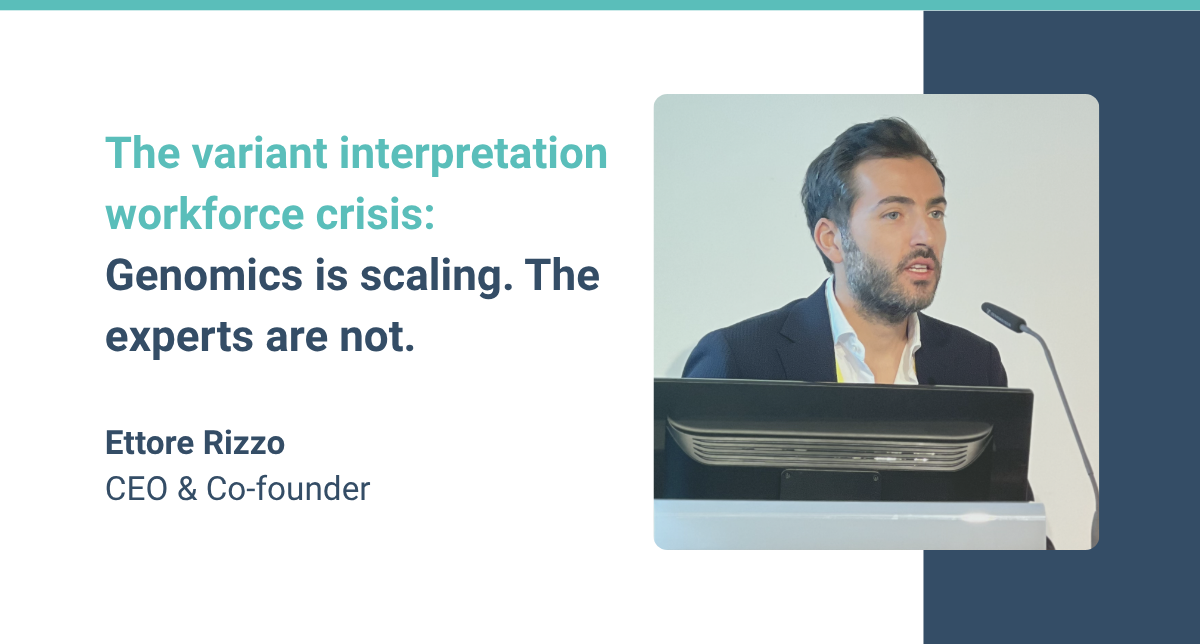
Genomic medicine has a throughput problem. And it is not the sequencers.
Over the past decade, the cost of whole genome and exome sequencing has fallen dramatically, national genomic programmes have expanded, and rare disease diagnostics have moved from specialist research centres into routine clinical care. The rare disease genetic testing market, valued at approximately $1.1 billion in 2024, is projected to grow at a compound annual rate of over 15% through 2030. The machines are keeping pace. The people who interpret what those machines produce are not.
At the centre of this bottleneck is a role most people outside clinical genomics have never heard of: the variant scientist.
A Profession Without a Pipeline
Variant scientists, the specialists who analyse sequencing output and determine whether a detected genetic variant is pathogenic, benign, or somewhere in between, represent one of the most consequential yet least understood roles in modern medicine. Despite apparent and growing demand for this expertise, remarkably little has been formally known about this workforce until very recently.
A 2025 survey published from Washington University School of Medicine, one of the first systematic attempts to characterise the role, painted a picture of a profession that is highly qualified, largely self-trained, and operating without formal recognition from professional organisations. Of the variant scientists surveyed, 92% held advanced degrees, 38% at master's level and 47% at doctoral level, yet 78% reported that their relevant training had been received on the job rather than through structured programmes. https://www.jmdjournal.org/article/S1525-1578(25)00169-2/fulltext
That last figure is striking. A profession requiring doctoral-level knowledge, with no formalised training pathway, growing into a market that is expanding at double-digit rates annually. The arithmetic does not work.
The VUS Problem at Scale
To understand why variant interpretation is so difficult to automate away, it helps to understand what variant scientists are actually doing.
Each of us carries more than 4 million genetic variants, including more than 20,000 in the exome alone. The vast majority have no clinical significance. A small number are definitively disease-causing. And a frustratingly large proportion sit in a grey zone, classified as variants of uncertain significance, or VUS, where the available evidence is insufficient to draw a firm conclusion either way.
It’s estimated that between 30 and 50% of sequencing reports return with at least one variant of uncertain significance. In rare disease specifically, where conditions are often tied to novel or unique variants not yet catalogued in population databases, that proportion is probably even higher. Each of those inconclusive results requires expert human review. Evidence must be gathered, weighed, and interpreted against evolving classification guidelines. In one cohort of approximately 1.6 million individuals, the mean time elapsed for a VUS to be reclassified to benign or likely benign was over 30 months, and reclassification to pathogenic took an average of over 22 months. For the families waiting on answers, those are not abstract timelines. https://pmc.ncbi.nlm.nih.gov/articles/PMC10600581/
A Workforce Crisis With Roots in Structural Neglect
The shortage of genetics professionals is not a new observation. Concerns about the shortage of genetic professionals in the United States have persisted for over 20 years, with the American Board of Medical Genetics and Genomics identifying workforce shortage issues as far back as its 2003 national assessment. https://www.sciencedirect.com/science/article/abs/pii/S109836002500108X
What is new is the scale of the gap between supply and demand.
In 2023, there were an estimated 9,293 genetic professionals across all disciplines in the United States, comprising clinical geneticists, genetic counselors, laboratory geneticists, and related roles. Variant scientists, as a distinct professional category, are not yet formally counted in these workforce surveys at all. The profession sits in an institutional gap: too specialised for general molecular biology training, not formally recognised by the boards and professional organisations that certify and count clinical geneticists.
The 2025 Washington University survey found that variant scientists themselves perceive that resources and recognition from professional organisations are currently lacking, a polite way of saying that the profession is scaling through informal networks and on-the-job learning while the formal infrastructure of the field has not caught up.
Standardised, high-quality variant interpretation training has historically been ad hoc and variable, with existing programmes lacking the capacity to reach the entire workforce. Attempts to address this through online learning, including massive open online courses targeted at genetic counselors entering variant interpretation, are promising but nascent.
The Automation Question
The obvious response to a human capital shortage at this scale is automation. And indeed, AI-driven variant interpretation tools are proliferating rapidly, with platforms promising to triage variants, prioritise clinically relevant findings, and reduce the burden on human reviewers. The 2025 ACMG Annual Meeting saw several new AI-powered diagnostic products launched specifically targeting rare disease variant classification.
The honest answer, however, is that automation addresses the easy end of the problem. Classifying a well-characterised pathogenic variant in a well-studied gene is increasingly something a validated algorithm can do reliably. Classifying a novel missense variant in a gene with limited functional data, in a patient from a population that is underrepresented in genomic databases, in the context of a phenotype that does not cleanly match any existing disease category, that remains a task requiring deep human expertise.
The majority of VUSs are missense changes, and more VUSs are observed per sequenced gene in individuals from non-European populations, precisely the populations that genomic medicine most needs to serve better, and precisely where automated tools trained on majority-population data perform least well. https://pmc.ncbi.nlm.nih.gov/articles/PMC10600581/
Automation will raise the floor. It will not replace the experts needed to handle the ceiling.
The Path Forward
The variant interpretation workforce crisis will not resolve itself. Expanding demand, insufficient training infrastructure, and a professional category that sits outside formal recognition systems is a combination that produces shortages, not equilibrium.
What is needed is a structural shift in how we define "the expert.": This includes formal training pathways at graduate and post-graduate level; professional recognition and certification frameworks that create career visibility and standardised competencies; investment in genomic databases that better represent global population diversity, reducing the proportion of variants that remain genuinely unclassifiable; but it also requires a fundamental pivot in our relationship with technology. We are moving past the era where AI is merely a "triage tool" for the easy cases.
AI is beginning to "jump in" where it was previously excluded: the complex reasoning required for VUS reclassification. By synthesizing vast amounts of disparate literature, predicting protein effects, and identifying subtle phenotypic patterns across global databases, AI is no longer just raising the floor, it is beginning to help humans reach the ceiling.
The sequencing capacity already exists to offer genomic diagnostics at meaningful scale across rare disease, paediatric medicine, oncology, and beyond. The rate-limiting step is no longer the hardware, but the interpretive bandwidth. The solution lies in an augmented workforce where AI handles the data-heavy lifting of evidence aggregation, allowing the rare, highly-trained variant scientist to transition from a manual researcher to a high-level assessor.
Until this synthesis of AI and human expertise scales to match the ambition of genomic medicine, patients will continue to receive reports that say, in effect: we found something, but we cannot yet tell you what it means. For families in the middle of a diagnostic odyssey, that is not a technical footnote. It is the whole problem.