Articles
ACMG SVC v4.0: A Significant Step Forward for Rare Disease Genomics
By Susanna Zucca, CSO, enGenome
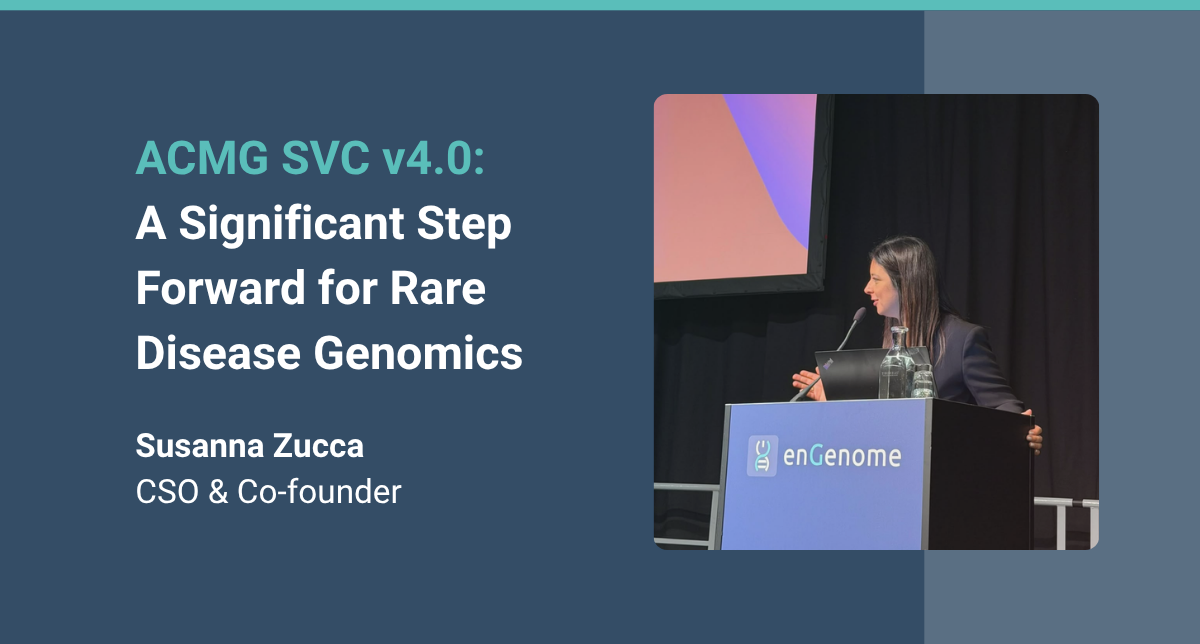
For clinical genomics laboratories involved in rare disease diagnosis, variant interpretation remains one of the most challenging and consequential steps in the diagnostic journey.
While sequencing technologies continue to improve, generating genomic data has become only part of the equation. The real challenge lies in accurately interpreting the clinical significance of genetic variants and translating those findings into meaningful answers for patients and their families.
This is why the recent evolution of the ACMG/AMP variant interpretation framework, culminating in the ACMG/AMP/CAP/ClinGen Sequence Variant Classification Recommendations v4.0 (SVC v4.0), is such an important milestone for our field.
Why Variant Interpretation Standards Matter
The original ACMG/AMP guidelines, published in 2015, transformed genomic diagnostics by providing a structured framework for variant classification. For the first time, laboratories had a common language and methodology for assessing pathogenicity.
Over the last decade, however, our understanding of human genetics has expanded dramatically. Millions of additional variants have been curated, large-scale population databases have matured, disease-specific expertise has grown, and new forms of evidence have become available.
As a result, the genomics community has increasingly recognized the need for greater precision, consistency, and reproducibility in variant interpretation.
SVC v4.0 represents the culmination of years of work by ACMG, AMP, CAP, ClinGen, and numerous expert working groups to address these challenges.
From Guidelines to Greater Consistency
One of the most significant goals of SVC v4.0 is reducing interpretation variability between laboratories.
Historically, different laboratories could occasionally arrive at different classifications for the same variant despite reviewing similar evidence. While such discrepancies are often understandable given the complexity of genomic data, they can create uncertainty for clinicians and patients.
The updated framework introduces greater structure around evidence evaluation and classification criteria, helping laboratories apply evidence more consistently and transparently.
For rare disease patients, where a single variant classification can determine whether a diagnosis is made or remains elusive, this consistency is particularly important.
Greater harmonization across laboratories ultimately means greater confidence in genomic results.
What This Means for Rare Disease Diagnosis
Rare disease genomics presents unique challenges.
Many patients carry variants that have never been observed before or have limited supporting evidence. Clinical laboratories are frequently required to assess incomplete datasets and make decisions in areas where scientific knowledge continues to evolve.
The updated framework helps address these realities by providing a more refined approach to evidence assessment and classification.
In practical terms, this may support:
- More consistent interpretation of rare and novel variants
- Improved reproducibility across laboratories
- Better alignment between clinical and research findings
- Increased confidence in diagnostic reporting
- Greater opportunities for data sharing and collaborative interpretation
For patients navigating long diagnostic odysseys, even incremental improvements in interpretation accuracy can have a profound impact.
The Operational Challenge for Clinical Laboratories
While the scientific benefits are clear, implementation will not be without challenges.
Adopting updated interpretation frameworks requires significant effort from clinical laboratories. Existing workflows may need revision. Historical variant classifications may require review. Interpretation teams must adapt to new evidence structures and decision-making processes.
This comes at a time when many laboratories are already facing increasing test volumes, workforce constraints, and growing pressure to reduce turnaround times.
As genomic medicine continues to scale, manual interpretation alone becomes increasingly difficult to sustain.
Why Technology Will Play a Critical Role
The transition to SVC v4.0 reinforces the growing importance of intelligent interpretation platforms.
Modern variant interpretation requires the integration of multiple evidence sources, literature databases, population datasets, phenotype information, and guideline frameworks. Managing this complexity manually is both time-consuming and difficult to scale.
Software solutions can help laboratories operationalize evolving guidelines, automate evidence collection, standardize workflows, and improve consistency across interpretation teams.
Importantly, technology should not replace scientific expertise. Rather, it should enable geneticists and clinical scientists to focus their attention on the most complex and clinically meaningful decisions.
As interpretation standards become more sophisticated, the laboratories best positioned for success will be those that combine expert human judgment with scalable computational support.
Looking Ahead
The final pilot phase of SVC v4.0 marks another important step in the maturation of clinical genomics.
The genomics community has spent the last decade building the evidence, expertise, and infrastructure needed to improve variant interpretation. These updated recommendations reflect how far the field has progressed and provide a roadmap for even greater consistency and accuracy in the future.
For rare disease patients, this matters enormously. Every improvement in interpretation quality increases the likelihood of reaching an accurate diagnosis, informing clinical management, and providing answers that can change lives.
The challenge now is implementation. Laboratories must translate these advances into routine clinical practice while maintaining efficiency, quality, and scalability.
That is where the combination of scientific expertise, collaborative standards, and advanced interpretation technology will continue to play a critical role in the future of genomic medicine.