Articles
The WGS Paradox: Why Clinical Genomics Is Advancing Faster Than Reimbursement Models
By Ettore Rizzo, CEO, enGenome
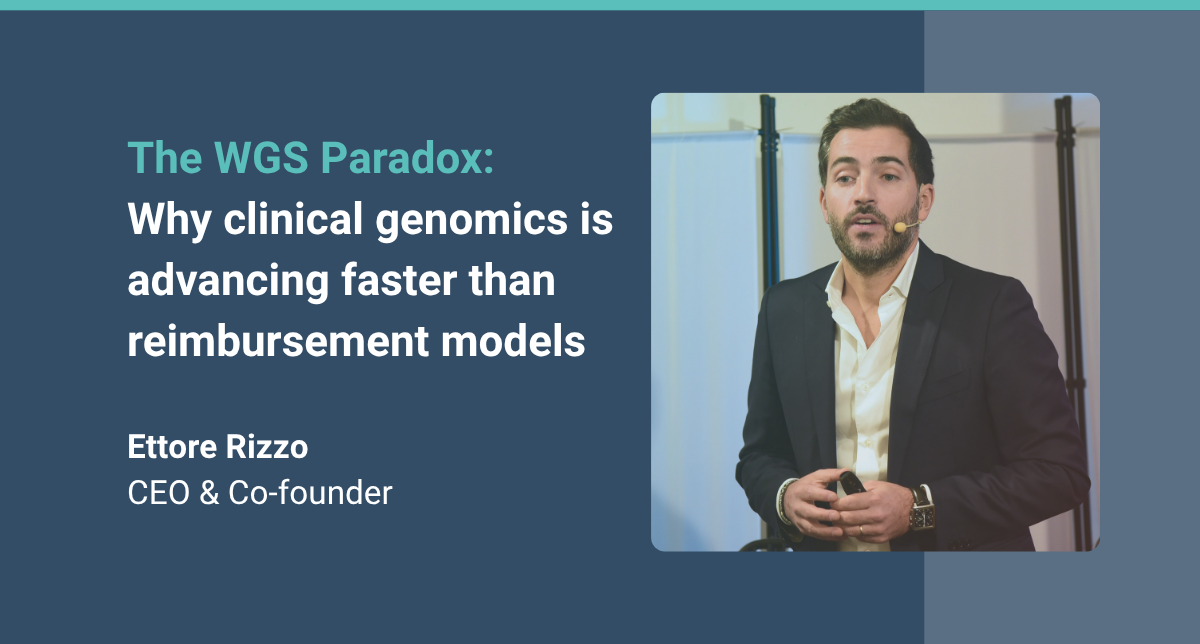
As the global human genetics community prepares to gather for ESHG 2026 in Gothenburg, it feels like an important moment to reflect on one of the defining tensions shaping the future of clinical genomics.
Scientifically, the field is moving rapidly toward whole genome sequencing (WGS) as the most comprehensive diagnostic approach available. Economically and operationally, however, many healthcare systems still behave as though exome sequencing remains the endpoint. This disconnect is becoming increasingly difficult to ignore.
Background
Over the last decade, whole exome sequencing transformed rare disease diagnostics by dramatically improving diagnostic yield compared to sequential single-gene testing and targeted panels. For many patients, particularly children facing long diagnostic odysseys, exome sequencing fundamentally changed clinical care.
But as we all know, genomics does not stand still. Today, whole genome sequencing is increasingly demonstrating its value in cases where exomes reach their limits. Structural variants, repeat expansions, deep intronic mutations, regulatory variants, complex rearrangements, and difficult-to-map regions of the genome are all areas where WGS can provide additional clinical insight that exome approaches may miss. The emergence of long-read WGS is further expanding these capabilities, improving resolution across repetitive and structurally complex regions of the genome that have historically remained difficult to characterise using short-read technologies.
As sequencing costs continue to decline and analytical pipelines mature, the scientific rationale for broader adoption of WGS is becoming increasingly compelling.
Reimbursement Dynamics Across Markets
Yet reimbursement systems have not evolved at the same pace. In many markets, exome sequencing continues to receive stronger payer support, clearer coding structures, and more predictable reimbursement pathways than genome sequencing. This creates a growing structural tension for diagnostic laboratories and healthcare providers: the test considered “best for the patient” may not yet align with financially sustainable operational models.
Importantly, this tension looks very different depending on geography.
In the United States, discussions around WGS adoption are often heavily shaped by commercial reimbursement dynamics. Clinical laboratories operate in an environment where payer coverage, CPT coding structures, utilization management, and reimbursement rates strongly influence testing strategy. Even where clinical demand for WGS is increasing, reimbursement gaps can create real pressure on margins and operational scalability.
Europe presents a different picture.
Across many European healthcare systems, genomics is more closely integrated into publicly funded care pathways and national genomic initiatives. Countries including the UK, France, and several Nordic markets have made substantial investments in large-scale genome programs, often with stronger emphasis on long-term healthcare utility rather than short-term reimbursement economics alone.
At the same time, European systems face their own challenges: fragmented infrastructure, uneven access between countries, slower procurement cycles, limited bioinformatics capacity in some regions, and ongoing questions around standardization and data governance across borders.
In practice, both regions are navigating the same underlying issue from different directions: clinical genomics is advancing faster than the operational and economic frameworks required to fully support it.
And sequencing itself is only one part of the equation.
AI and the Interpretation Factor
The transition from exome to genome-scale diagnostics introduces significantly greater interpretative complexity. WGS, whether short or long read, generates far larger datasets and expands analysis into genomic regions where scientific understanding is still evolving. While this creates opportunities for improved diagnosis, it also increases the burden on laboratories, clinical scientists, reporting infrastructure, and downstream interpretation workflows.
This is where AI and computational platforms are becoming increasingly important. But the conversation around AI in genomics also requires nuance. In research settings, it is relatively easy to build models that prioritize variants or generate predictions. Translating these systems into regulated clinical environments is far more difficult. Clinical genomics requires explainability, reproducibility, auditability, and guideline-aligned interpretation workflows. Black-box automation alone is not enough. As laboratories scale WGS adoption, the real challenge is not simply generating more genomic data. It is enabling clinical teams to interpret that data accurately, consistently, and efficiently while maintaining confidence in every reported result.
enGenome’s CSO, Susanna Zucca, will be moderating a panel at ESHG titled Insights from Practice: AI-Guided Interpretation in Clinical-Grade Genomics, exploring some of these factors.
This is why the future of WGS adoption will depend not only on sequencing cost curves, but on the maturity of the surrounding ecosystem: scalable interpretation platforms, curated knowledge bases, clinical-grade AI assistance, and robust human oversight integrated into the workflow.
My Final Thoughts
I think it is important to make clear, this debate should not be framed as “WGS versus exome.” For many clinical scenarios today, exome sequencing remains highly effective, economically rational, and operationally appropriate. The industry is not facing a binary transition, but rather entering a period where diagnostic strategies will become increasingly stratified based on phenotype complexity, clinical urgency, healthcare infrastructure, and reimbursement realities.
The core question is how quickly the supporting systems around genomics can evolve to match the pace of scientific progress and how we can engage with key ‘non-science’ stakeholders, such as politicians, to ensure progress. The science is already moving forward. The challenge now is ensuring that healthcare systems, reimbursement structures, and operational models evolve alongside it!